
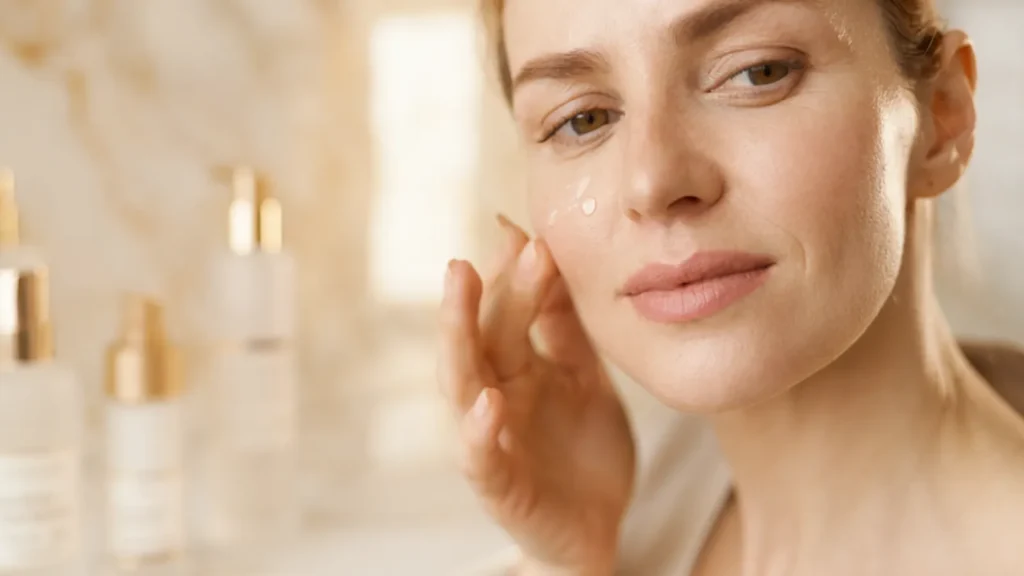
After your 30th birthday the skin changes noticeably: collagen production decreases by about 1% per year from age 25,¹ cell renewal slows down, and the skin gradually loses elasticity and moisture. Establishing the right routine now can significantly slow the visible aging process – completely without procedures.
At Beauty Salon Glamour in Leipzig we advise clients every day who want to set the course for healthy, youthful-looking skin in exactly this phase of life. Here are the five most important care steps we recommend.
1. Gentle cleansing – the foundation of every routine
Morning and evening, wash your face with a mild, pH-neutral cleanser. Aggressive foam cleansers with sulfates destroy the natural skin barrier, leading to dryness, redness and, long-term, premature skin aging.²
Tip: Use lukewarm water (not hot!) and gently massage the cleanser in for 30 seconds. Afterwards, pat dry with a soft towel only.
2. Vitamin C in the morning – protection against free radicals
A vitamin C serum (ideally 10–20% L-ascorbic acid) neutralizes free radicals caused by UV radiation, environmental pollution and stress. Studies show that topically applied vitamin C stimulates collagen synthesis and helps prevent pigmentation.³
Important: Always apply vitamin C in the morning, followed by sun protection – the combination amplifies its protective effect.
3. Hyaluronic acid – moisture that works
Hyaluronic acid is a natural substance found in the body that can bind up to 1,000 times its own weight in water. With age, the natural content in the skin decreases. A hyaluron serum or moisturizer with both high- and low-molecular hyaluronic acid optimally supplies different skin layers.
For particularly dry skin, we additionally recommend professional skin booster treatments – here, highly pure hyaluronic acid is introduced into the skin with ultra-fine needles and develops its effect over months.
4. Retinol in the evening – the anti-aging gold standard
Retinol (vitamin A) is one of the most scientifically researched active ingredients against skin aging. It accelerates cell renewal, smooths fine lines and refines the complexion. A landmark study showed measurable wrinkle improvements after 24 weeks of use as early as 2007.⁴
How to start: Begin with a low concentration (0.1–0.3%) twice a week, then slowly increase. Always apply in the evening only – retinol makes skin sensitive to light. Avoid retinol during pregnancy and breastfeeding.
5. Sun protection – the most important anti-aging ingredient
About 80% of visible skin aging is caused by UV radiation (“photoaging”), not chronological aging.⁵ A well-known long-term study at Queensland University in Australia proved that daily use of SPF 15+ visibly slowed skin aging over 4.5 years.⁶
Our recommendation: At least SPF 30, every day – even in winter and on cloudy days (UVA radiation penetrates clouds and window glass). Mineral filters (zinc oxide, titanium dioxide) are especially skin-friendly.
Bonus: Professional support
A consistent home routine is the foundation – but professional treatments can significantly accelerate the process:
- Hydrating Facial every 4–6 weeks: deep cleansing, peeling, intensive hydration
- Microneedling every 6–8 weeks: stimulates natural collagen production
- Skin booster with hyaluron every 4–6 months: long-lasting skin firming from within
We’re happy to advise you personally on which treatment fits your skin. Contact us or book an appointment directly via Treatwell.
Sources
- Shuster S, Black MM, McVitie E. The influence of age and sex on skin thickness, skin collagen and density. Br J Dermatol. 1975;93(6):639-43.
- Mukhopadhyay P. Cleansers and their role in various dermatological disorders. Indian J Dermatol. 2011;56(1):2-6.
- Pullar JM, Carr AC, Vissers MCM. The Roles of Vitamin C in Skin Health. Nutrients. 2017;9(8):866.
- Kafi R et al. Improvement of naturally aged skin with vitamin A (retinol). Arch Dermatol. 2007;143(5):606-12.
- Flament F et al. Effect of the sun on visible clinical signs of aging in Caucasian skin. Clin Cosmet Investig Dermatol. 2013;6:221-32.
- Hughes MC et al. Sunscreen and prevention of skin aging: a randomized trial. Ann Intern Med. 2013;158(11):781-90.
This article is for informational purposes and does not replace medical or dermatological advice.