
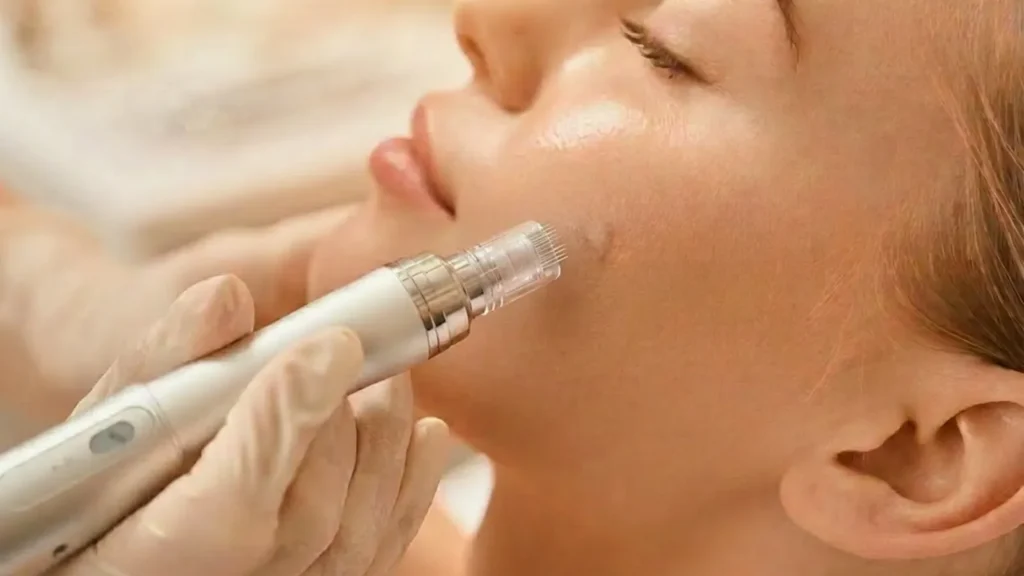
Microneedling – also called “Collagen Induction Therapy” (CIT) – is one of the most discussed treatments in modern aesthetic medicine. But does it really work? What do the studies say? And who is it suitable for? We provide a scientifically based overview.
What exactly happens during microneedling?
During microneedling, ultra-fine sterile needles (length 0.25 mm to 2.5 mm, depending on indication) create targeted micro-injuries in the skin. These micro-channels activate three central regeneration processes:
- Inflammation phase (day 1–3): growth factors are released
- Proliferation phase (day 4–14): fibroblasts produce new collagen and elastin
- Remodeling phase (weeks to months): the new collagen matrix matures
The result: firmer, smoother and visibly rejuvenated skin – without thermal damage like in laser therapy.
What do studies say about effectiveness?
Landmark study 2008
The German research group led by Dr. Matthias Aust (Hannover Medical School) published a landmark paper in the renowned journal Plastic and Reconstructive Surgery: In 480 patients, microneedling showed significant improvement in wrinkles, scars and skin laxity – histologically proven by a significant increase in collagen and elastin.¹
Acne scars: up to 80% improvement
An Italian study on 32 patients with acne scars (Fabbrocini et al., 2009) showed an average improvement of scar depth by 57% after two microneedling sessions.² A larger review (Alster & Graham, 2018) confirms: microneedling is a safe, effective treatment for atrophic acne scars with results comparable to fractional laser therapy.³
Wrinkles and skin aging
A South Korean study (El-Domyati et al., 2015) examined 10 patients with photoaging and wrinkles before and after six microneedling sessions two weeks apart. Result: significant increase in type I and type III collagen as well as elastin – microscopically documented.⁴
Who is microneedling suitable for?
The treatment is particularly suitable for:
- First signs of skin aging (fine lines, loss of firmness)
- Atrophic acne scars and post-inflammatory hyperpigmentation
- Enlarged pores
- Pregnancy and stretch marks
- Tired, dull skin without visible glow
When is microneedling NOT suitable?
You should avoid microneedling in case of:
- Active skin infections (herpes, bacterial infections)
- Acute acne flare-ups with inflammatory pustules
- Tendency to keloid scarring
- Blood clotting disorders or use of blood thinners
- Pregnancy and breastfeeding (as a precaution)
- Skin cancer in the areas to be treated
Dermaroller vs. professional microneedling
Cheap dermarollers (from €15) are sold in drugstores and online as “home microneedling”. We strongly advise against this. The reasons:
- Home devices have needle lengths under 0.3 mm and can hardly stimulate collagen
- Non-sterile conditions lead to infection risks
- Wrong technique can cause pigmentation disorders, scars and skin damage
- Needles become dull over time and tear the skin
Professional microneedling is performed with medically certified devices (e.g. Dermapen 4, SkinPen Precision), sterile single-use attachments and consideration of individual skin parameters.
What should you consider after treatment?
- Day 1–2: Light redness like a sunburn, possibly minimal swelling
- Day 3–7: Gentle skin peeling possible – don’t scratch off!
- 48 hours: No make-up, no sauna, no sport, no direct sunlight
- 2 weeks: Consistent SPF 50+ sun protection, mild care without acids/retinol
How many sessions are necessary?
For visible results, most dermatologists recommend 3–6 treatments at intervals of 4–6 weeks. Maintenance treatments every 6–12 months sustain the result long-term.
Microneedling at Beauty Salon Glamour
At our salon in Leipzig, we work exclusively with medically certified microneedling devices and maintain the highest hygiene standards. Before every treatment, a thorough skin analysis and consultation takes place – we only recommend the treatment if it makes real sense for your skin type and goals.
Book a consultation now or call us at +49 15510 664870.
Sources
- Aust MC et al. Percutaneous collagen induction therapy: an alternative treatment for scars, wrinkles, and skin laxity. Plast Reconstr Surg. 2008;121(4):1421-9.
- Fabbrocini G et al. Acne scarring treatment using skin needling. Clin Exp Dermatol. 2009;34(8):874-9.
- Alster TS, Graham PM. Microneedling: A Review and Practical Guide. Dermatol Surg. 2018;44(3):397-404.
- El-Domyati M et al. Microneedling therapy for atrophic acne scars: an objective evaluation. J Clin Aesthet Dermatol. 2015;8(7):36-42.
This article is for informational purposes and does not replace medical or dermatological advice. Before each treatment, we hold a personal consultation in our salon.